
At present, China has built a world-leading new energy vehicle industrial system relying on the liquid lithium-ion battery industry. However, the existing lithium-ion batteries use a flammable liquid electrolyte, making it difficult to simultaneously meet the urgent needs of electric vehicles, energy storage, electric aviation, intelligent terminals, and other industries for high energy density, high safety, long life, and low-cost lithium batteries. Solid-state batteries with high energy density, high safety, and long life are globally recognized as one of the disruptive technologies to replace existing lithium-ion batteries.
Why: Solid-state batteries have the advantages of good safety, high energy density, etc.
Li-ion batteries are mainly composed of anode materials, anode materials, electrolyte, and diaphragm, of which the electrolyte plays a role in transporting lithium ions and conducting internal current. The core of the liquid battery to solid state battery is to replace the electrolyte + diaphragm with a solid electrolyte.
Figure: Comparison of the composition of solid-state batteries and liquid batteries.
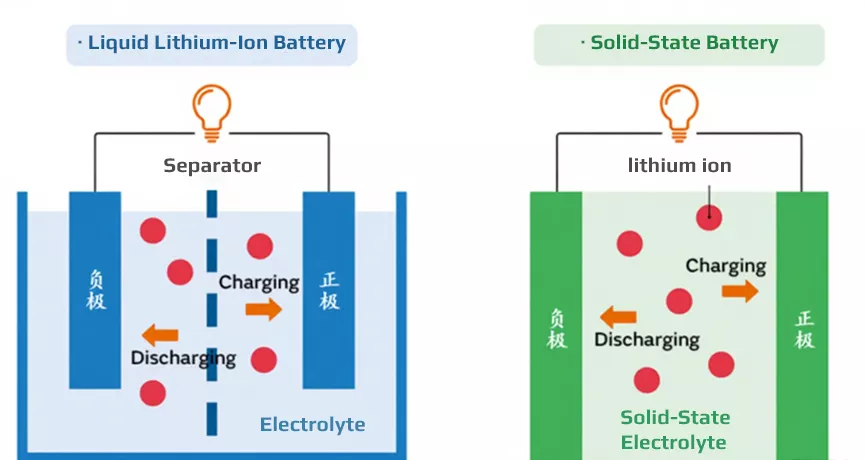
The organic solvent in the liquid electrolyte is flammable, highly corrosive, has poor oxidation resistance and other characteristics, and can not solve the problem of lithium dendrites. There is a risk of thermal runaway, resulting in liquid lithium-ion battery safety performance and energy density to further enhance the many obstacles faced by:
And solid-state batteries in a solid-state electrolyte instead of a liquid electrolyte, liquid batteries, a septum, shrinking the quality of the battery pack and the size of the battery, so that the solid-state batteries are not easy to ignite and explode and have good thermal stability, high energy density, long cycle life, better charge and discharge performance, and other advantages. Solid-state batteries have the advantages of being non-flammable and thermally stable, having high energy density, long cycle life, and better charging and discharging performance.
① Non-flammable and good thermal stability.
Battery energy density is high.
② High battery energy density.
Better charging and discharging performance.
What: Comparison of Three Major Technology Routes for Solid State Batteries
The different technology routes for solid-state batteries are mainly categorized by the type of solid-state electrolyte used. According to the different electrolytes, solid-state batteries are mainly divided into three major technology routes: polymer electrolyte, oxide electrolyte, and sulfide electrolyte. Among them, sulfide electrolytes have the greatest potential for development in all-solid-state batteries.
Ideal solid-state electrolyte materials should have high ionic conductivity, chemical and electrochemical stability to lithium metal, good inhibition of lithium dendrite generation, low preparation cost, no need to use rare metals, and other characteristics. However, the current three major technology routes have their own advantages and disadvantages; no can meet the above requirements at the same time, there is still a certain degree of difficulty in the technological breakthrough.
① Polymer electrolyte: the advantages of polymer are easy to process, more compatible with the existing electrolyte production equipment and processes, and good mechanical properties. Its disadvantages include: (i) ionic conductivity is too low, and the performance is greatly affected at low temperature, and it usually needs to be charged and discharged normally at high temperature (more than 60℃); (ii) chemical stability is poor, and it cannot be applied to high-voltage cathode materials, and it will be on fire at high temperature; (iii) electrochemical window is narrow, and the electrolyte is easy to be electrolyzed when the potential difference is too large (>4V), which makes the upper limit of the performance of polymer (iii) narrow electrochemical window (>4V) electrolyte is easily electrolyzed when the potential difference is too large, making the upper limit of polymer performance lower.
② oxide electrolyte: its advantages include better electrical conductivity and stability, ionic conductivity is higher than the polymer, thermal stability up to 1000 ℃, mechanical stability and electrochemical stability are better. Its disadvantages include: (i) relative to sulfide, its ionic conductivity is low, making the oxide solid-state battery in the process of performance enhancement will encounter a series of problems, such as capacity, multiplicity performance limitations; (ii) oxide is very hard, resulting in solid-state batteries have a rigid interface contact problem, in the case of a simple cold pressure at room temperature, the battery’s porosity is very high, which may lead to the battery can not work properly.
③ Sulfide electrolyte: the highest ionic conductivity, strong machinability, good interfacial contact, low interfacial resistance, and a wide window of electrochemical stability (above 5V), excellent performance, and the greatest potential for development in all-solid-state batteries. Its shortcomings include: (i) unstable interface, easy to react with the positive and negative materials, resulting in high interface impedance, leading to increased internal resistance; (ii) at the level of the preparation process, the preparation process of sulfide solid-state batteries is relatively complex, and sulfide is easy to react with the moisture in the air and oxygen to produce hydrogen sulfide and highly toxic gases; (iii) the cost is relatively high, and there is a large room for cost reduction of core materials such as lithium sulfide.
Comprehensively speaking, polymer electrolyte has the most rapid development, more mature technology, the earliest to promote the commercialization of applications, have achieved small-scale mass production, but there are shortcomings such as low conductivity, the upper limit of the performance is lower, and have not been spread on a large scale up to now. Oxide electrolyte performance in all aspects of the performance is more balanced, the current progress is faster, mainly used in the field of semi-solid state battery. Sulfide electrolyte has the highest ionic conductivity, the best performance, the most suitable for all-solid-state batteries, commercialization potential, but the current preparation is difficult, high cost, and how maintaining high stability issues also need to be resolved. In summary, it can be seen that the breakthrough of the key technical problems of solid-state electrolytes will be expected to greatly accelerate the process of solid-state battery industrialization.


