
In the history of power battery development, the liquid lithium battery has appeared in lithium iron phosphate, lithium ternary materials, lithium manganate, lithium titanate, and other technology routes. Ternary materials once occupied more than 90% of the share of passenger cars, and ultimately, lithium iron phosphate is expected to achieve a competitive advantage in the market.
Currently, solid-state batteries are globally recognized as one of the ultimate goals of power battery development, and all countries are striving to achieve breakthroughs. Solid-state batteries also have a variety of technology routes, oxides, sulfides, polymers, halides, and other technology routes are involved in different organizations, which technology routes are the most promising?
February 15-16, 2025, the second China all-solid-state battery innovation and development summit forum was held in Beijing, with more than 300 experts gathering to discuss the development of all-solid-state batteries. The speech of Minggao Ouyang, academician of the Chinese Academy of Sciences and chairman of the China All-Solid State Battery Industry-University-Research Collaborative Innovation Platform, conveyed a clear message: in 2025, the development of all-solid-state batteries will determine the main technical route.
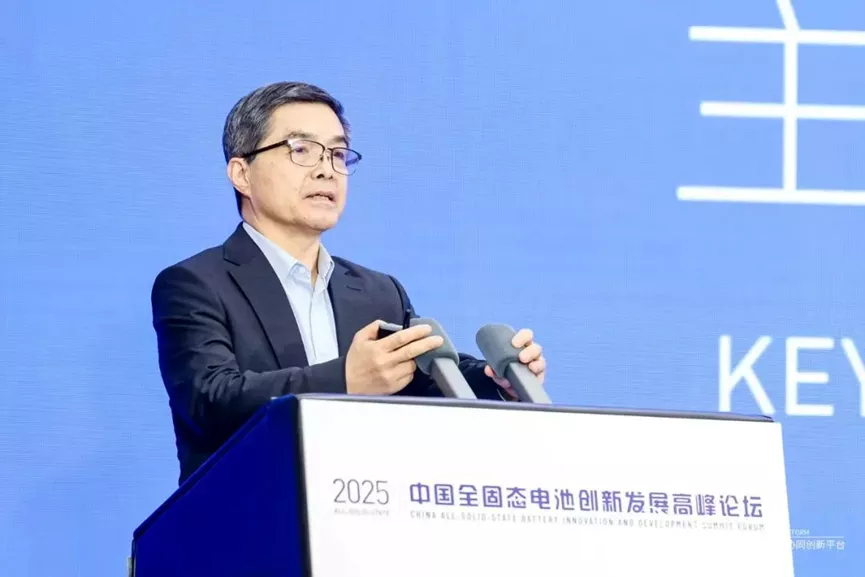
Focus on preventing the subversive risk brought by the all-solid-state technology route.
Academician Minggao Ouyang reviewed Japan’s all-solid-state battery technology roadmap 2020, which focuses on all-solid-state batteries, with solid-state electrolyte sulfide as the mainstay, ternary as the mainstay of cathode materials, and volumetric specific energy as a landmark parameter index.
Compared to foreign countries, at present, China’s power battery enterprises and organizations are characterized by semi-solid state (solid-liquid hybrid). In the process of power battery development, semi-solid state is not a transition strategy that can improve the safety of power batteries.
Ouyang Minggao said, “The all-solid-state battery has reached a critical period, the need to establish a technical route, which is related to the sustainable and healthy development of China’s new energy automobile industry.”
From a global perspective, all-solid-state batteries are gradually focusing on the sulfide technology route, and the investment continues to increase. Reporters carefully counted, the world’s about 32 companies and organizations focus on the sulfide technology route, with no more than 10 R&D oxide solid-state batteries, and 7 R&D polymer solid-state batteries. Some of these companies focus on the sulfide route, but do not give up the oxide and polymer route.
Combining the global solid state battery development, we can see that the consensus is to focus on the breakthrough of 500Wh/kg or less battery before 2030, the ternary anode remains unchanged, the main change of the negative electrode, and the positive electrode will be changed after 2030.
Positive and negative electrode materials are key.
In the field of all-solid-state batteries, positive and negative electrode materials are very critical, and Ouyang Minggao proposes that a battery company is both a battery product manufacturer and a material company.
In the negative electrode materials, graphite/low silicon, high silicon silicon carbon, and lithium metal three categories are in the spotlight, and silicon carbon is the focus before 2030. Japan’s NEDO SOLiD-Next project (2023-2027) uses a high-nickel ternary graphite anode system with a weight energy density of 200~300Wh/kg, focusing on high-power, long-life all-solid-state batteries. The challenge of the lithium anode is mainly reflected in the growth of dendrites and volume expansion. The formation of lithium dendrites becomes “dead lithium”, and volume expansion reduces the interface of high reactivity.
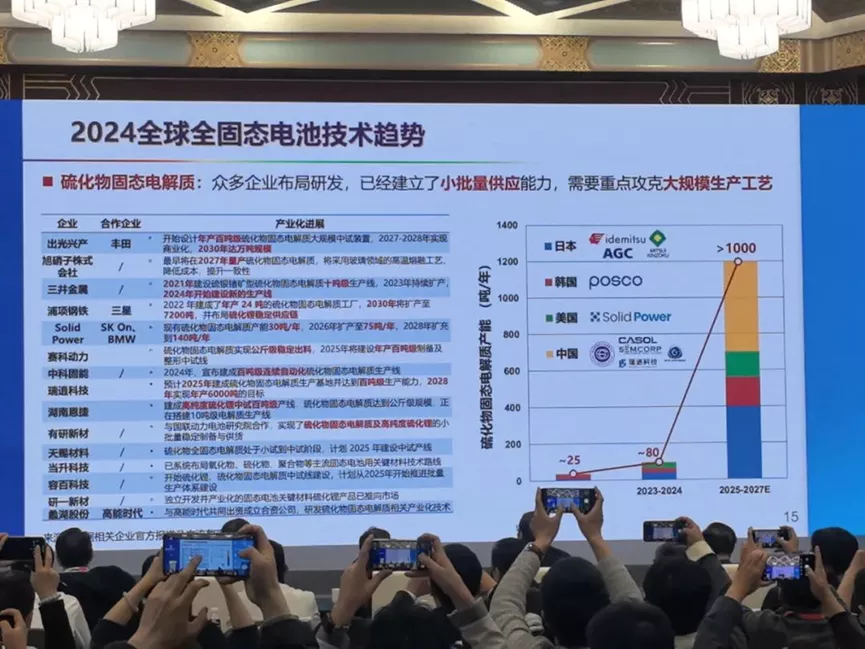
According to reports, the world has a large number of enterprises laying out sulfide solid electrolyte, and the establishment of small batch supply capacity is focusing on tackling the large-scale production process. Toyota cooperation enterprise Izumi Kogyo is one of them, began designing the annual output of 100 tons of sulfide solid electrolyte large-scale pilot plant, 2027-2028 commercialization, and 2030 up to 10,000 tons scale. Among the domestic enterprises, SECCO Power, Zhongke Solid Energy, and Ruizhan Technology are also making efforts. SECCO Power’s sulfide solid state electrolyte has achieved kilogram-level stable feedstock, and will build a 100-ton annual output preparation and shaping pilot line in 2025; Zhongke Solid Energy announced the completion of a 100-ton continuous automated production line of sulfide solid state electrolyte by the end of 2024; and Ruizhan Technology expects to complete the sulfide solid state electrolyte production base in 2025 and reach the 100-ton production capacity by 2025. In 2025, Ruizeng Technology is expected to build a production base for sulfide solid-state electrolyte and reach 100-ton production capacity, and in 2028, it will achieve the goal of an annual production capacity of 6000 tons.
Ouyang Minggao pointed out that the establishment of a solid-state battery technology route needs to answer three questions:
- sulfide, oxide, polymer, halide, which is the main technology route?
- When is the time of mass production?
- What mean to achieve mass production?
He further said that what can be put into mass production is the most difficult to predict. Sometimes, a difficult problem for a long time did not get solved, mass production time had to be postponed, sometimes maybe at a certain point in time, to achieve a major breakthrough, the mass production process is very smooth.


